Pages

Saturday, March 31, 2012

Mahseer (National Fish of Pakistan)


Masheer is the National Fish of Pakistan.The word Masheer is made up of two local words: Maha means "big" and sher means "lion".They are commercially important game fish, as well as highly esteemed food fish.


Mahseer is the common name used for the genera Tor, Neolissochilus, and Naziritor in the family Cyprinidae (carps). Mahseer fetch high market price, and are potential candidate species for aquaculture. Several of the larger species have suffered severe declines, and are now considered threatened due to pollution, habitat loss and overfishing.


Mahseers inhabit both rivers and lakes, ascending to rapid streams with rocky bottoms for breeding. Masheer are omnivorous, eating not only algae, crustaceans, insects, frogs, and other fish, but also fruits that fall from trees overhead.


The first species from this group were scientifically described by Francis Buchanan-Hamilton in 1822, and first mentioned as an angling challenge by the Oriental Sporting Magazine in 1833.In addition to being caught for sport, mahseer are also part of commercial fishing and ornamental or aquarium fish.


Wednesday, March 21, 2012

SNOW LEOPARD (State Animal of Pakistan)


The Snow leopard (Uncia uncia) is a state animal of Pakistan. Snow leopards live between 3,000 and 5,500 metres (9,800 and 18,000 ft) above sea level in the rocky mountain ranges of Central and South Asia. It has been estimated that between 3,500 and 7,000 snow leopards exist in the wild and around 300 are in Pakistan.


Snow leopards show several adaptations for living in a cold mountainous environment. The snow leopard has a short muzzle and domed forehead, containing unusual large nasal cavities that help the animal breathe the thin, cold air of their mountainous environment.In summer, snow leopards usually live above the tree line on mountainous meadows and in rocky regions at an altitude from 2,700 to 6,000 m (8,900 to 20,000 ft). In winter, snow leopards come down into the forests to an altitude of around 1,200 to 2,000 m (3,900 to 6,600 ft).


Snow leopards are smaller than the other big cats. They generally weigh between 27 and 55 kg (60 and 120 lb. Body length ranges from 75 to 130 cms (30 to 50 inches), with the tail adding a further 80 to 100 cm (31 to 39 in) to that length. These cats stand about 60 cm (24 in) at the shoulder.


Snow leopards have long thick fur, and their base color varies from smoky gray to yellowish tan, with whitish under parts. They have dark gray to black open rosettes on their body with small spots of the same color on their heads and larger spots on their legs. Their eyes are pale green or gray in color. Their bodies are solid with thick fur. Their ears are small and round .Their paws are wide, which distributes their weight better for walking on snow, and have fur on their undersides to increase their grip on steep and unstable surfaces; it also helps to minimize heat loss. Snow leopards' tails are long and flexible, helping them to maintain their balance, which is very important in the rocky terrain they inhabit. Their tails are also very thick due to storage of fats and are very thickly covered with fur which allows them to be used like a blanket to protect their faces when asleep.


Snow leopards cannot roar, despite possessing partial ossification of the hyoid bone. Larynx is absent in snow leopard which create ability to roar Sound is generated in the larynx, and that is where pitch and volume are manipulated. Snow leopard vocalizations include hisses, chuffing, mews, growls, and wailing. Prusten is a sound made by the snow leopard, also known as chuffing or chuffle The animal's mouth is closed and it blows through the nostrils, producing a breathy snort. This sound is non-threatening and often used when two big cats encounter each other on neutral territory, or between courting pairs.


Snow leopards usually mate in late winter, marked by a noticeable increase in marking and calling. The Snow Leopards have a gestation period of 90–100 days, so that the cubs are born between April and June.


The animals usually give birth to two to three cubs in a litter, but can give birth to up to seven in some cases.The mother gives birth in a rocky den or crevice lined with fur shed from her underside. Litter sizes vary from one to five cubs, but the average is 2.2. The cubs are blind and helpless at birth, although already with a thick coat of fur, and weigh from 320 to 567 grams (11 to 20.0 oz). The eyes open at around seven days, and the cubs can walk at five weeks and are fully weaned by 10 weeks. Also when they are born they have full black spots and turn into rosettes as they grow up The cubs leave the den at around two to four months of age, but remain with their mother until they become independent after around 18–22 months.


Snow leopards are carnivores and actively hunt their prey.They can kill animals three times their size but will readily take much smaller prey such as hares and birds. Snow leopards are crepuscular, being most active at dawn and dusk. They are known for being extremely secretive and well camouflaged. Snow leopards prefer to ambush prey from above, using broken terrain to conceal their approach, and can leap as far as 14 meters (46 ft).They kill with a bite to the neck, and may drag the prey to a safe location before feeding.


The snow leopard leads a largely solitary life. An individual snow leopard lives within a well-defined home range, but does not defend its territory aggressively when encroached upon by other snow leopards, snow leopards use scent marks to indicate their territory and common travel routes. These are most commonly produced by scraping the ground with the hind feet before depositing urine or scat, but they also spray urine onto sheltered patches of rock.


Snow leopards normally live for 15–18 years, although in captivity they can live for up to 21 years.


.

Monday, March 19, 2012

SADABAHAR FLOWER


Sadabahar 's batanical name is Vinca Rosea. It bears flowers in all the seasons. Sadabahar' means 'always in bloom'  Sadabahar is a small shrub. It rejoices in sun or rain, or the seaside, in good or indifferent soil and often grows wild. Numerous soft-wood branches from the ground, give it an appearance of fullness. It has impressive effect with its various colours. The flower comes in various colours and combinations. The star-like 5 petaled flowers are white, pink or red. They can also be in two colours with a different coloured centre. The leaves are silky glossy dark green.


The plant is multiplied easily by seeds or cuttings. In fact near the mother plant often a great number of self-seeded young plants appear, which are very fast growing and sturdy. In the tropicals it is good to do a heavy pruning three four times a year.


Sadabahar (Vinca Rosea) has a vast field of applications. It contains an alkaloid which is a heart poison. Leaves are applied to wasp-sting. Sadabahar have been used for cramps, luplesia, diarrhoea, sore throat, inflamed tonsils. It is also called Sorcerer's Violet because witches and sorcerers used it for making potions. It is said it can help in fighting cancer.Now a days, the leaves and roots of the Sadabahar are used in the pharmaceutical industry and in ayurvedic medicines to treat different diseases like diabetes, hypertension and cancer.


Tuesday, January 17, 2012

JIWANI PORT (BALUCHISTAN-PAKISTAN)


Jiwani is a town and commercial port that is located along the Gulf of Oman in the Gwadar District of the Balochistan province in Pakistan. It is located near the Pakistani border with Iran.Jiwani lies to the extreme west on the Makran coast, close to the Pakistan - Iran border. Jiwani is rich in biodiversity.Being free from pollution, Jiwani is reminiscent of a South Sea island, with vast sandy beaches giving onto the clean, clear green waters of the Arabian Sea.

The area around the bay includes an important mangrove forest extending across the international border.It is an important habitat for a wide variety of wildlife, especially the endangered Olive Ridley and Green Turtles.

Green Turtles at  JIWANI  COAST

Olive Ridley Turtle


There are a number of export oriented fish freezing plants located in Jiwani. Jiwani is 34 km from the Iranian border.town hosts a small naval base and an airport with a 5,500-foot runway.


The special thing about Jiwani is that it was used during the World War II as an allied base and the remains of some bases are still available. Visiting the barracks area of the base used during the World War 2 in Jiwani reveals many handwritten small stories and names of allied Pilots.


There is another story linked to Jiwani and that is that Queen Victoria planned to visit the area to watch the "sunset" and a hut was built for her, which is now known as the "Victoria Hut".  The Victoria Hut is still maintained by the Pakistan Coast Guards up to the present day.

Victoria Hut

Sunset at Jiwani
There is a water system which is now abandoned for use but is a marvel of civil works and holds great uniqueness for meeting water requirements of the base. It used to store rain water in three stages in order to clean the water using its usual flow. The water was then pumped to the base and also up to the Victoria Hut which is nearly 5 km from the water tank system.


Recently, WWF-Pakistan established the Jiwani Conservation and Information Centre (JCIC). The aim is to contribute towards the conservation of biodiversity in the area, through information dissemination.Located at a site overlooking the Arabian Sea, the JCIC contains facilities for seminars, meetings etc. It has exhibits/displays related to the surrounding biodoversity.

Jiwani Conservation and Information Centre

Mangrove Nursery at Jiwani

Mangrove Forest at JIWANI
Jiwani Airport is situated 10 km away from the city centre of Jiwani in Balochistan. It is not a major airport of Pakistan. At this time, there is no scheduled service to or from the airport.

Monday, October 31, 2011

MUD VALCANOES IN BALUCHISTAN, PAKISTAN


The Baluchistan province of Pakistan is gifted with a diverse geography. Among many geological wonders, one big attraction is the presence of mud volcanoes. In Baluchistan there are more than 80 active mud volcanoes. World’s largest and highest known mud volcano is located in Baluchistan. The altitude of highest mud volcano here is 300 ft. dormant mud volcanoes stand like columns of mud in many other areas. There are about 10 locations having clusters of mud volcanoes. . The mud volcanoes of Baluchistan are not only located on the land but from time to time they appear as small temporary islands in the Arabian Sea. Similar mud volcanoes have been identified on Mars planet.


Mud volcanoes are also located in the Makran range of mountains. In the west, in Gwadar District, the mud volcanoes are very small and mostly be situated in the south of Jabal-e-Mehdi toward Sur Bandar. Many more exist in the north-east of Ormara. The other are in Lasbela District and are scattered between south of Gorangatti on Koh Hinglaj to Koh Kuk in the North of Miani Hor in the Hangol Valley. In this region, the heights of mud volcanoes range between 800 to 1,550 feet (243.8 to 472.4 m). Most mud volcanoes in this region are situated in out-of-reach areas having very difficult terrain.


HINGOL MUD VALCANO
Hingol mud volcano is located in Makran District, Baluchistan Province of Pakistan. It is a mud volcano located in Hingol National Park. The mud is rather cool.


NEZ-E-SULTAN
Neza e Sultan) is located in Chagai District, Baluchistan, Pakistan. Neza e Sultan is an extinct volcano and only the magma chamber remains and it looks like a spear. Neza means spear; Sultan means King; literally Spear of Sultan.


CHANDRAGUP
Chandragup is a mud volcano located in Baluchistan, Pakistan. The mud volcano ‘Chandrakup’ means 'Moon Well'. The volcano is filled with mud, instead of magma, hence the term "mud volcano". The height of chandragup mud volcano is approximately 300 meters. The most famous is Chandaragup. The biggest crater found at 25°33'13.63"N. 65°44'09.66"E is about 450 feet (137.16 m) in diameter. Chandrakup volcano is considered holy by Hindus and is an important stop for pilgrims on their way to the shrine of Devi (goddess) Hinglaj.


JEBEL-E-GHURAB
 Jebel-e-Ghurab is located in Baluchistan, Pakistan. It is a mud volcano.


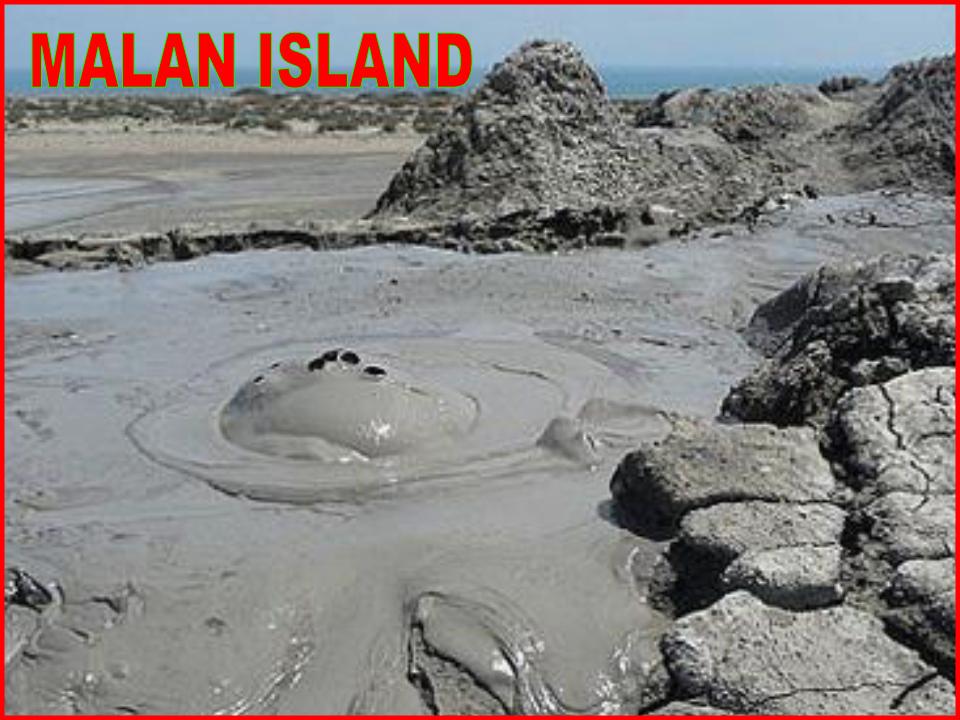
MALAN ISLAND
Malan Island is actually an offshore mud volcano located in the Arabian Sea, 3 kilometers off the coast of Baluchistan, Pakistan.


The term mud volcano or mud dome is used to refer to formations created by geo-excreted liquids and gases, although there are several different processes which may cause such activity. Hot water mixes with mud and surface deposits Temperatures are much cooler in these processes than found at igneous volcanoes. About 86% of the gas released from these structures is methane, with much less carbon dioxide and nitrogen emitted. Ejected materials are often slurry of fine solids suspended in liquids which may include water, which is frequently acidic or salty, and hydrocarbon fluids.